

LinSig3.2 : SCATS Modelling Computer Workshop
Overview
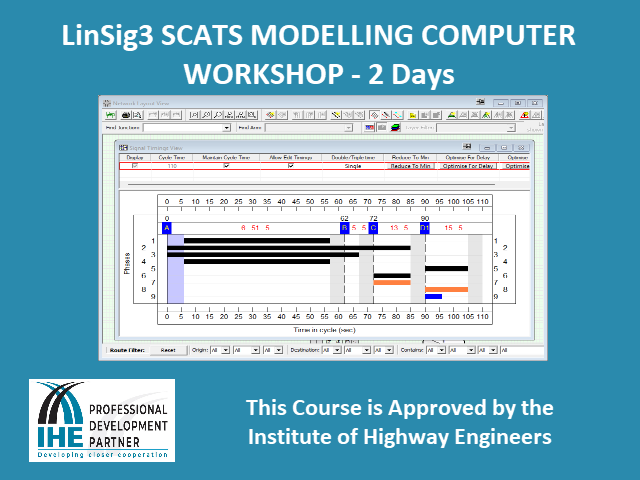
LinSig3.2 can seamlessly be switched from UK based TOPAS 2500 mode to SCATS mode. The SCATS controller model replicates SCATS Signal Groups, Phases, Clearance Times and Pedestrian Protection. SCATS mode also supports the import of flows directly from SCATS dump files with automatic data searching and aggregation.
This one day supplementary course covers the use of LinSig3s key SCATS based features. The course is computer based with practical workshop exercises.
Who should attend
This course is suitable for anyone who is already familiar with basic LinSig modelling or who has attended the previous two day LinSig Junction Modelling course. The LinSig3 Junction Modelling course and the SCATS course run concurrently and are available as a discounted three day bundle.
Prerequisites
Delegates are expected to have a basic understanding of LinSig modelling and of SCATS based terminology such as Signal Groups, Phases and Clearance Intervals (although a brief revision of terminology session will be provided at the start of the course).
Accreditation
All JCT courses are Approved or are pending Approval by the Institute of Highway Engineers and attendance is therefore recognised by the IHE and many other bodies as evidence of Continual Professional Development (CPD).
Courses are managed under a ISO9001 Quality Management System.
Course content
Since 1985, LinSig has been the industry standard modelling software for traffic signal design and assessment. This one day workshop is key training for anyone wishing to extend their LinSig modelling skills to include the modelling of SCATS controlled junctions and networks. The Sydney Coordinated Adaptive Traffic System (SCATS) has been adopted by twenty seven countries around the world including Australia, New Zealand and Ireland (Dublin).
Upcoming Courses
Express your interest in this course
If you have interest in this course but are still undecided or not yet in a position to make a formal booking then you may like to express your interest in this course by filling in the fields below. This allows us to contact you first should we feel interest might be low/high or if we are considering re-scheduling or cancelling the course. Often just one or two places is enough to make the difference between a course that runs or one that is cancelled.
We will not give your details to anyone else and we will only use this information to let you know about developments pertinent to this particular course. All fields are required except for the requests/notes and organisation fields.