

LinSig3 : Networks and Advanced Features Computer Workshop
Overview
Accurate LinSig modelling is fundamental to traffic signal design, transport assessments for development and detailed studies where traffic signal junctions are a major determinant of transport outcomes.
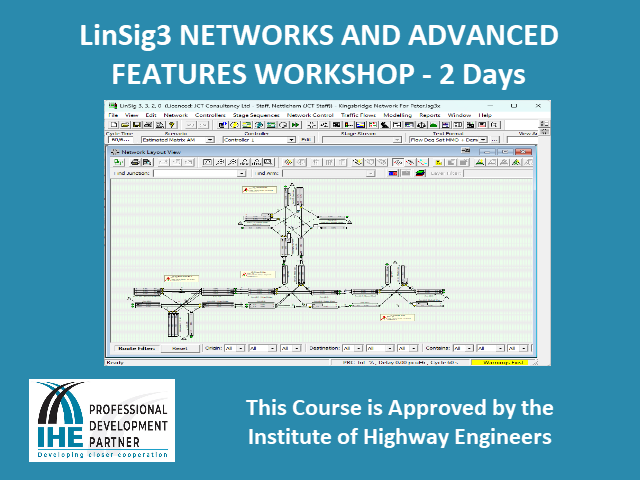
This course takes up where the LinSig 3 Junction modelling workshop finishes and covers the use of LinSig 3 to model highway networks containing traffic signal junctions, priority junctions and roundabouts. It also covers a range of more advanced LinSig features relevant to both junctions and networks. The course is computer based with practical workshop exercises being used throughout.
Who should attend
This course is suitable for anyone who requires a more in depth knowledge of LinSig or wishes to model networks using LinSig and wishes to ensure their modelling is robust and accurate.
As well as being suitable for those who have recently completed the LinSig 3 Junction Modelling Workshop it is also suitable for experienced LinSig users who wish to ensure they are up to date with the many network modelling features added to LinSig since the release of LinSig 3. The course is also appropriate for anyone who, whilst not building models themselves, are required to authorise or audit LinSig network models submitted by others.
Prerequisites
Delegates are expected to have a basic understanding of how traffic signals work and know what is meant by terms such as phase, stage, intergreen, saturation flow and capacity. This and much more can be gained by either attending the JCT Introduction to Traffic Signals 2 day course or the one day JCT Essentials of Traffic Signals for Modellers. These courses are usually held immediately prior to each LinSig Junction Modelling Workshop, and can be attended as part of a discounted training bundle.
Delegates should also have sufficient knowledge or experience of LinSig 3 to be able to at least build a LinSig 3 model of a single junction. LinSig junction model building skills can be attained by attending the LinSig3 Junction Modelling Workshop which is usually held immediately prior to this course.
Accreditation
All JCT courses are Approved or are pending Approval by the Institute of Highway Engineers and attendance is therefore recognised by the IHE and many other bodies as evidence of Continual Professional Development (CPD).
Courses are managed under a ISO9001 Quality Management System.
Course content
Since 1985, LinSig has been the industry standard modelling software for traffic signal design and assessment.With the release of version 3, LinSig’s capabilities were extended to larger networks with features such as matrix estimation and delay based assignment.
The course involves extensive computer usage and covers the following topics:
Day 1
Understanding Cyclic Flow profiles in the context of a complicated double junction and applying cruise times, platoon dispersion and platoon compression.
Vehicle movements through successive stop lines with explanations of coordination, flow graphs, queue graphs, platoon dispersion and platoon compression.Double junction modelling with both single and parallel stage streams.
Using LinSig3 give-way parameters to model priority junctions and also conventional roundabouts on a lane by lane basis.
Larger networks of junctions with multiple controllers.Importing and merging LinSig 3 and LinSig 2 single junction models.Matrix estimation from junction counts, delay based assignment and checking of routes through networks.
Day 2
Working with multiple controllers, controller sets and network control plans and using multiple cycle times in a network model.
Advanced assignment and matrix estimation options including customised and behavioural assignment, limiting Degrees of Saturation, weighting of cruise times and using partial and prior matrices.
Lane Based flow entry with use of multiple layers and combining Lane Based and Matrix Based flows in the same network model.
Modelling buses by the use of both bus layers and bus zones, including the modelling of bus dwell times, bus lanes, pre signals and bus set-backs (including the use of bonus greens).
Importing TranEd models into LinSig3.
Express your interest in this course
If you have interest in this course but are still undecided or not yet in a position to make a formal booking then you may like to express your interest in this course by filling in the fields below. This allows us to contact you first should we feel interest might be low/high or if we are considering re-scheduling or cancelling the course. Often just one or two places is enough to make the difference between a course that runs or one that is cancelled.
We will not give your details to anyone else and we will only use this information to let you know about developments pertinent to this particular course. All fields are required except for the requests/notes and organisation fields.