

Practical Application of MOVA Computer Workshop including the use of MOVA Tools and MOVA Simulation
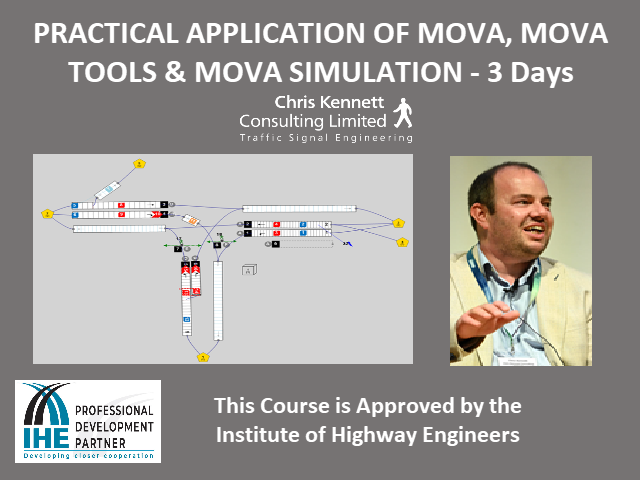
This course is designed for Traffic Signal Professionals involved in the design of Traffic Signal Installations which use Microprocessor Optimised Vehicle Actuation (MOVA) to optimise traffic signal timings. The course begins with basic theory of MOVA but moves quickly onto the practical application of MOVA including specifying detectors, building Datasets and using MOVA Tools and MOVA Simulation on laptops which are supplied. Configuring MOVA outstations and integrating MOVA with SCOOT are also covered. The course has a lectured format with workshops to consolidate the learning and comprehensive notes and training materials are provided.
Who should attend.
Attendees should have a good basic understanding of UK traffic signals including Phases, Stages, Intergreens and Interstages. These topics are covered on other JCT courses such as “An Introduction to Traffic Signals”. Whilst it is not imperative to have extensive site experience attendees should have at least a very basic understanding of the components of a Traffic Signal Installation including the structure of Controllers, Detector Loops and Out Station Transmission Units.
Prerequisites.
Understanding of UK Phases, Stages, Intergreens and Interstages, basic understanding of Traffic Signal Installations
Course content.
The following topics are covered:
Introduction to MOVA: Basic theory of MOVA operation, Benefits of MOVA, Estimating MOVA modelling the benefits
MOVA Design: Types of MOVA detectors, locations and uses, Alternatives to loops for MOVA detectors, Options for right turn control under MOVA, Staging a junction for MOVA
Controller Specification: Writing relevant pages of ITS1827 to specify MOVA interface including UTC Interface, Phase Confirms and Detectors, Special Conditions
Workshop Exercises – Design and Specification: Setting out of detectors on a plan, considering road speeds and how to control right turns. Creating appropriate stages, a stage order and specify the MOVA Interface.
Structure of a MOVA Dataset: Explanation of the basic structure of a MOVA dataset, consisting of links, lanes, detectors and stages, and the definition of each.
MOVA Tools: Working through MOVA Tools, looking at the structure and parameters for Controllers, Signals, Matrices, Links, Lanes, Detectors, SD Codes
Workshop Exercises – Dataset: Writing the relevant controller specification forms and configuring a MOVA Dataset using MOVA Tools and MOVA Simulation for the site designed in the prior workshop.
MOVA Versions and Hardware: Versions and facilities, Integral platforms, Non-integral Outstations
Communicate and Configure MOVA Outstations: Connecting and communicating, Basic configurations, Uploading and downloading datasets
Integrating MOVA with SCOOT: Configuring and controlling MOVA on a SCOOT Site, using UG405 and basic commands.
Validating MOVA Operation: Principles of why and how MOVA is validated, understanding: Troubleshooting common errors and problems, Key validation parameters and what to check, Signs of a well-configured MOVA installation
Express your interest in this course
If you have interest in this course but are still undecided or not yet in a position to make a formal booking then you may like to express your interest in this course by filling in the fields below. This allows us to contact you first should we feel interest might be low/high or if we are considering re-scheduling or cancelling the course. Often just one or two places is enough to make the difference between a course that runs or one that is cancelled.
We will not give your details to anyone else and we will only use this information to let you know about developments pertinent to this particular course. All fields are required except for the requests/notes and organisation fields.